How Rangers and Researchers Use QR Codes to Protect Wildlife
Published on July 3, 2026 · 5 min read
How Rangers and Researchers Use QR Codes to Protect Wildlife
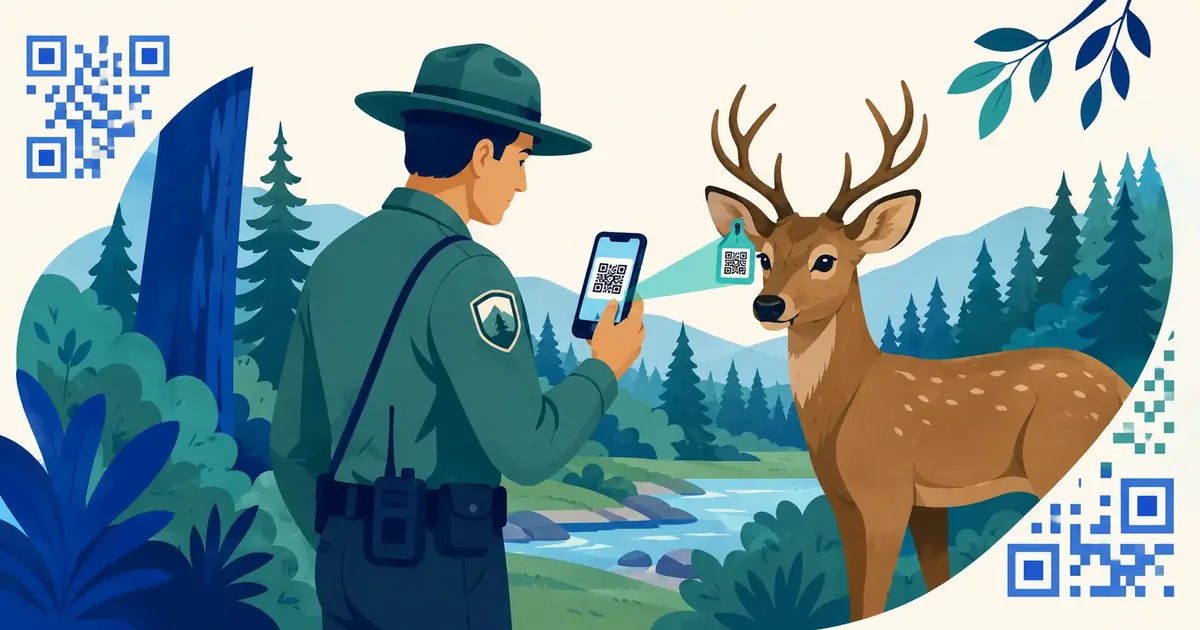
A ranger kneels beside a tranquilized deer at dawn, gloves on, clock ticking. She has maybe ten minutes before the animal needs to be released. In that window she scans a small tag, and its full history opens on her phone: last capture date, weight trend, vaccination notes, and the exact spot it was tagged two years ago. No paper forms. No radio call back to base.
That's the unglamorous, genuinely useful side of conservation tech. A QR code won't save a species on its own, but it removes the friction that slows the people who might.
The Field Data Problem
Conservation runs on data, and field data is a mess by nature. Teams work in rain, mud, and fading light, often miles from any signal. Paper datasheets get soaked. Handwritten IDs get misread. And when three researchers record the same animal three slightly different ways, the dataset quietly rots.
A QR code cuts through that. A durable tag on an enclosure, a transport crate, or a release site links straight to a structured record. Everyone scans the same code and reaches the same file, so the data stays clean no matter who's holding the phone.
Where Conservation Teams Actually Use Codes
This isn't theory. Codes show up across the whole workflow, in ways that save real time.
- Individual animal records. Tags on transport crates or temporary holding pens link to an animal's capture history, health notes, and genetics.
- Sample tracking. Blood and tissue samples get coded so they never lose their link to the animal they came from on the way to a lab.
- Camera-trap and equipment logs. A code on each device opens its service history and last battery change, so nothing gets missed on a long circuit.
- Release-site mapping. A code at a site records what was released there and when, building a map over time.
Because the code only points to a record, the data itself stays in the team's secure system. Our explainer on static vs dynamic QR codes covers why that link-based setup is so useful when details change often.
A Real Scenario: The Handoff
Picture an injured hawk moving from a rescue center to a rehabilitation facility three hours away. Normally that handoff is where information leaks: the driver forgets a detail, the receiving team re-asks questions, and the bird's medication schedule gets muddled.
With a coded tag on the carrier, the receiving vet scans it the moment the hawk arrives. Up comes the injury, the drugs given and when, and the feeding plan. Treatment continues without a gap. The code didn't do anything clever. It just carried the facts across a handoff that usually drops them.
What to Store, and What to Protect
Not all conservation data should be open. Some of it, like the location of a rare nest or an endangered animal, is dangerous in the wrong hands. Poachers use open data too.
So the rule is simple: sensitive records sit behind a login, and only field-safe basics go on any public-facing tag. A code on an educational trail sign can share a species' story freely. A code tied to a specific radio-collared animal should reveal nothing to a random scanner. The U.S. Fish and Wildlife Service publishes guidance on handling sensitive species data that's worth following before any field rollout (fws.gov), and the IUCN Red List remains the standard reference teams link to for species status (iucn.org).
Get the access levels right first. Speed is only an asset when it doesn't help the wrong people.
Building Tags That Survive the Wild
Field gear takes a beating that office labels never see. A code that fails in month two is worse than useless, because the team stops trusting the system.
Here's what holds up outdoors:
- Etched metal or industrial-grade tags, not printed stickers, for anything permanent.
- High contrast and generous size, so a code still scans when it's dusty or partly worn.
- Dynamic codes, so a record can move to a new database without re-tagging animals or crates.
- A backup ID printed in plain text beside the code, in case a scanner ever fails in the field.
- A quick monthly scan check on high-use tags to catch fading before it causes a gap.
The public-education side deserves the same care. Trail signs and visitor centers use these codes to teach, much like zoo exhibit codes do, turning a walk in a reserve into a self-guided lesson.
The Public-Education Payoff
Field efficiency is only half the story. The other half is that a scan turns any visitor into a student for a minute or two, and that reach is hard to match any other way.
A code on a trailhead sign can open a short video of the very animal that lives in that habitat, explain why it matters, and show what a hiker can do to protect it, like staying on marked paths or packing out food scraps. That's a far stronger message than a weathered sign nobody stops to read.
It also stretches a small team's voice. A reserve might have two staff and ten thousand annual visitors. Nobody can guide all those people, but a well-placed code guides each of them a little. Over a season, that adds up to thousands of quiet lessons delivered without a single extra staff hour.
And because the pages are editable, the education stays current. When a species' status changes or a new threat appears, the team updates one page and every sign in the reserve reflects it the next day. The physical signs never move, but the message behind them keeps pace with reality.
Frequently Asked Questions
Do QR codes work without a signal in remote areas? The scan itself needs no signal, but opening an online record does. Teams working off-grid sync records to a phone or tablet beforehand, then scan and log offline, uploading later when they reach coverage.
Can't a poacher just scan a tag and find a rare animal? Not if it's set up correctly. Sensitive location data stays behind a login. Public tags carry only general, non-sensitive information, so a random scan reveals nothing useful to bad actors.
Are these codes expensive for a small nonprofit? Generating codes is free. The real costs are durable tags and the discipline to keep records current. It scales down to a single project without a big budget.
What stops the data from getting messy over time? Because everyone scans the same code to reach one shared record, there's a single source of truth per animal or sample. That alone prevents most of the duplication that plagues paper systems.
Small Tool, Real Leverage
Conservation is hard, slow work, and anything that removes friction matters. A QR code keeps field data clean, carries information safely across handoffs, and teaches the public without a ranger present. It's a small tool with real leverage. If your team is ready to try it, you can build your first durable record codes for free with the QRinsec generator and start cleaning up the paperwork today.
Published by the QRinsec Editorial Team — practical documentation about QR codes, barcode standards, and QRinsec’s client-side tools. Content is reviewed against product testing and published technical documentation from sources such as GS1, Denso Wave, and ISO standards where applicable.
Have questions or corrections? Contact us.
Create your QR code for free
No sign up, no limits — generate and download in seconds.
Open the generator