Never Miss a Feeding: A QR Code Care Schedule for Your Home Aquarium
Published on July 3, 2026 · 5 min read
Never Miss a Feeding: A QR Code Care Schedule for Your Home Aquarium
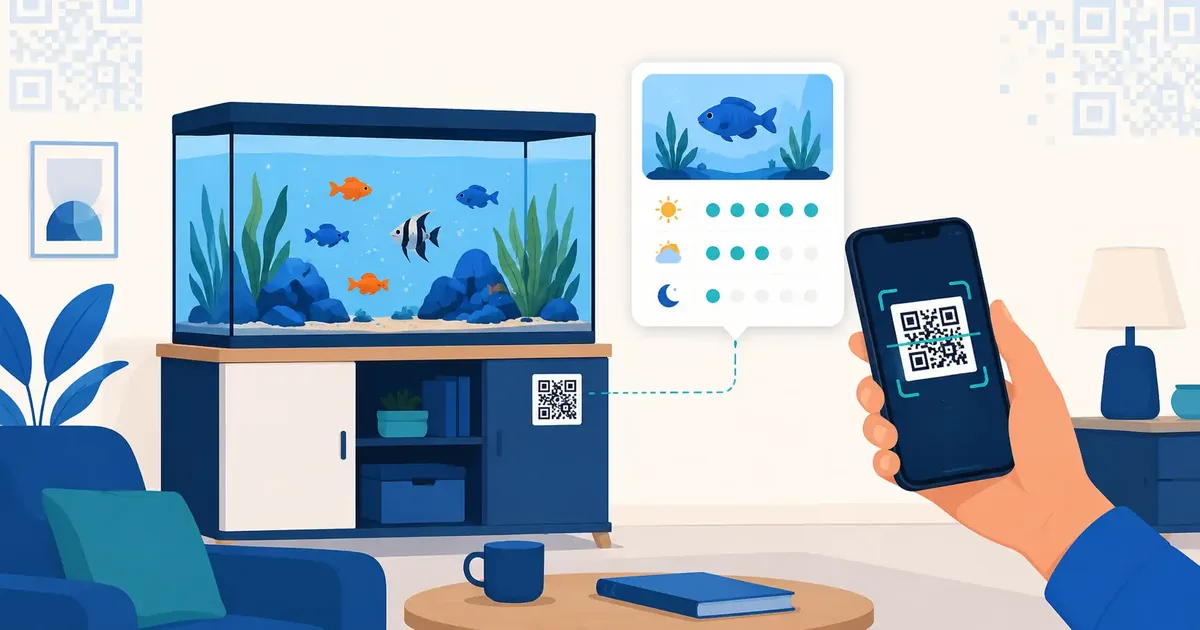
You're finally taking that week away, and the person watering your plants gives your fish tank a nervous look. "How much do I feed them?" You rattle off instructions in the doorway, they nod, and you spend the whole trip quietly worried they'll dump the whole jar in. A small QR card taped by the tank would have answered every question without you saying a word.
Home aquariums are less forgiving than they look. Overfeed by a little, skip a water change, and a healthy tank turns cloudy fast. A QR care schedule keeps the exact routine one scan from whoever is standing in front of the glass.
Why Fish Care Goes Wrong When You're Away
A tank runs on small, consistent habits, and those habits live in your head. You know this tank gets a pinch of food once a day, that the pleco needs a wafer twice a week, and that a quarter of the water gets changed every Sunday. A sitter knows none of it.
The classic failure is overfeeding. A well-meaning helper sees fish "begging" and feeds them three times a day, uneaten food rots, and ammonia spikes. By the time you're home the water is a mess and a fish or two is struggling. It's rarely neglect. It's just missing information at the moment it's needed.
What a QR Care Card Holds
The code on the card points to a simple page you control, updated from your phone whenever the routine changes. One tank, one card, one clear set of instructions.
A good aquarium care page usually covers:
- Exactly how much to feed, and how often, in plain terms like "one small pinch, once a day, morning only."
- Any special feeding, such as a sinking wafer for bottom-dwellers twice a week.
- The water-change schedule and how much to change.
- A short "do not" list: don't tap the glass, don't add anything, don't feed extra.
- Your phone number and your aquarium store's number for emergencies.
Because it lives on a page, you update it the day you add a new fish or change the routine, and the card by the tank is instantly current.
Static or Dynamic for a Care Card?
Go dynamic. A static code locks its destination forever, which is fine only if your routine never changes, and tanks always change. A dynamic code lets you edit the page or repoint it as your setup evolves, without reprinting the card. The guide on static vs dynamic QR codes explains the trade-off, but for a living tank with shifting needs, dynamic is the obvious pick.
A Vacation That Goes Smoothly
Picture the same trip, but now a laminated card sits beside the tank: "Scan for feeding and care." Your sitter scans it on day one and reads the whole routine in thirty seconds. One pinch of food each morning. Nothing else. A wafer on Wednesday. Don't change the water; you'll handle it when you're back.
When a fish looks lethargic mid-week, the sitter scans again, sees your note to "text a photo, don't add anything," and does exactly that. You talk them through it from the beach in two minutes. The tank stays healthy, the sitter stays calm, and you actually relax. That's the whole return on a five-minute setup.
What to Put on the Page (Keep It Simple)
The temptation is to write everything you know about fishkeeping. Resist it. A sitter needs a short, clear routine, not a manual.
Lead with feeding, because that's where most mistakes happen, and make the amount unmistakable. "One pinch" is vague; "fill the cap of the food jar to the first line, once a day" is not. Add only the tasks the sitter actually needs to do, and clearly mark what to leave alone. The less room for interpretation, the safer your fish.
If you keep a marine or reef tank, you can add a note about sustainable, responsible fishkeeping and where you source livestock. Seafood Watch is a useful reference for anyone who cares about ocean impact (seafoodwatch.org), and the Association of Zoos and Aquariums shares public guidance on aquatic animal care worth linking for curious sitters (aza.org).
Building a Card That Survives Beside Water
A care card lives in the splash zone, so treat it like it'll get wet, because it will.
- Laminate it or use waterproof card stock, then mount it where condensation won't ruin it.
- Keep the code big and high-contrast, so it scans in the low light near a tank.
- Stick it where a sitter will look, on the cabinet door or the wall beside the tank, not hidden behind it.
- Add a one-line prompt so the sitter knows to scan it.
- Test it before you leave, scanning with a phone that isn't yours to be sure it opens for a guest.
This home setup is the small-scale cousin of what public aquariums do with interactive tank codes. Same principle, kitchen-table version: put the knowledge one scan from the glass.
Set It Up in Four Steps
You can build this in one afternoon, well before your trip.
Step 1: Write the routine. Keep it short and specific, feeding first, then any weekly tasks, then the "do not" list.
Step 2: Create the page and code. Put the routine on a simple page and generate a dynamic code with the QR generator so you can edit it later.
Step 3: Print and laminate. Make the code at least an inch and a half wide, and protect the card against splashes.
Step 4: Test with someone else's phone. Confirm a guest can scan and read it, then mount it by the tank.
Do this once and every future sitter, houseguest, or forgetful you at 6 a.m. has the routine ready.
Frequently Asked Questions
Does my pet-sitter need a special app? No. Any modern phone camera reads the code and opens your care page. There's nothing to download, which matters when a casual helper is covering for you.
What if I change my fish's diet later? With a dynamic code, you just edit the page from your phone. The card by the tank stays the same and instantly shows the new routine.
Will the card survive the humidity near a tank? It will if you laminate it or use waterproof stock. Plain paper won't last, but a protected card handles splashes and condensation fine.
Can I use one card for multiple tanks? It's cleaner to give each tank its own card and page, so instructions never get mixed up. The codes are free to make, so there's no reason to share one.
Take the Worry Out of Leaving Your Tank
A fish tank doesn't need a fish expert to survive a week, it just needs the right routine in the right hands at the right moment. A QR care card puts your exact instructions one scan from whoever is helping, so overfeeding and guesswork stop being a risk. Set yours up before your next trip and travel without the nagging worry. You can build your care card for free with the QRinsec generator today.
Published by the QRinsec Editorial Team — practical documentation about QR codes, barcode standards, and QRinsec’s client-side tools. Content is reviewed against product testing and published technical documentation from sources such as GS1, Denso Wave, and ISO standards where applicable.
Have questions or corrections? Contact us.
Create your QR code for free
No sign up, no limits — generate and download in seconds.
Open the generator