UPC vs EAN Barcodes: Differences and When to Use Each
Published on June 28, 2026 · 5 min read
You have finalized your product design, perfected your packaging, and you are finally ready to start selling in retail stores. But before you can ship a single unit to a distributor or list it on Amazon, you hit a massive bureaucratic wall: you need a retail barcode.
You do a quick search and are immediately confronted with a confusing alphabet soup. Do you need a UPC? What about an EAN? Are they the same thing? If you pick the wrong one, will European retailers reject your shipment? Will American supermarkets refuse to stock it?
This confusion is incredibly common for new manufacturers and e-commerce sellers. Let us demystify the global retail barcode system. In this guide, we will break down the exact differences between UPC and EAN barcodes, and give you a definitive answer on which one you actually need.
A Tale of Two Continents
To understand why we have two different standards, you have to look at the history of retail technology.
In the early 1970s, the grocery industry in the United States and Canada needed a way to speed up checkout lines. They invented the UPC (Universal Product Code). It was a massive success, revolutionizing retail in North America.
A few years later, Europe realized they needed the same technology. However, they realized the American UPC system did not have enough capacity to handle the massive number of countries and manufacturers across Europe and Asia. So, they created the EAN (European Article Number) system, which was essentially an expanded, upgraded version of the UPC.
For decades, the global supply chain was split. If you wanted to sell a product in New York, you needed a UPC. If you wanted to sell that exact same product in London, you needed an EAN. It was an expensive logistical nightmare for international brands.
The Technical Breakdown: 12 Digits vs 13 Digits
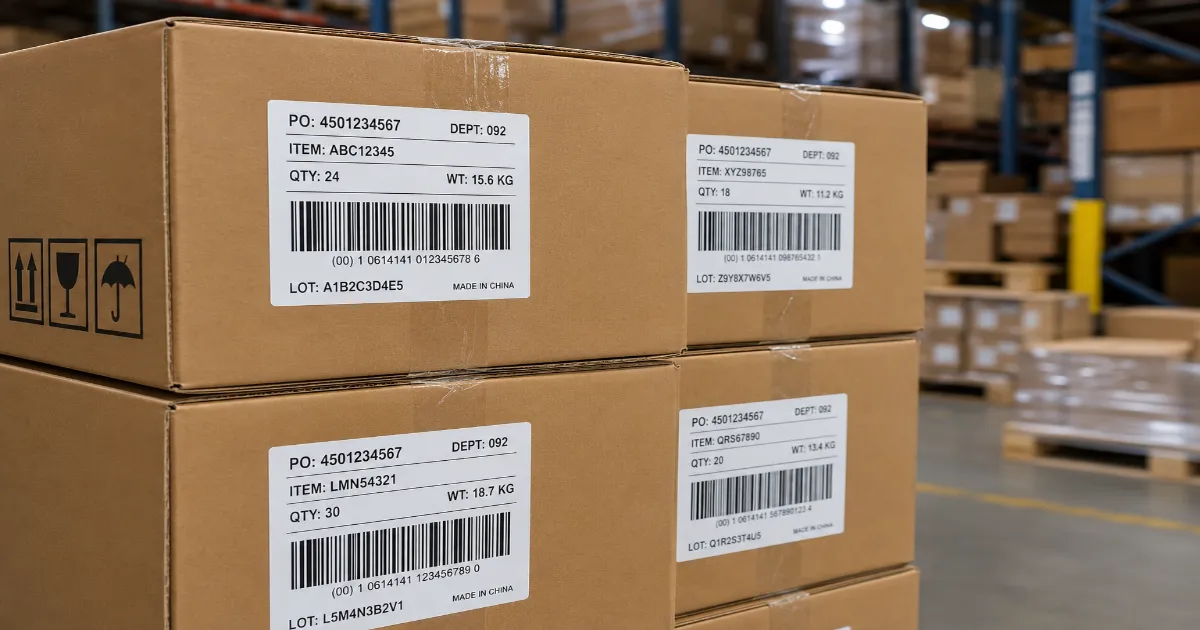
Visually, UPC and EAN barcodes look nearly identical to the untrained eye—just a block of vertical black lines with numbers underneath. The core difference lies in the number structure.
UPC-A (The North American Standard):
- Contains exactly 12 digits.
- The numbers represent a company prefix, a specific product number, and a mathematical check digit at the end to prevent scanning errors.
- It is managed by GS1 US.
EAN-13 (The Global Standard):
- Contains exactly 13 digits.
- It uses the same structure as the UPC, but it includes an additional number at the very beginning. This extra number acts as a "Country Code," identifying the specific GS1 member organization that issued the barcode.
- It is managed by the global GS1 organization.
*Fun Fact: A UPC-A is actually just an EAN-13 in disguise. If you take an American 12-digit UPC barcode and put a "0" at the very front of it, it mathematically becomes a perfectly valid 13-digit EAN barcode!*
The Sunrise 2005 Initiative (The Game Changer)
If the systems were split, how does global trade work today?
In the early 2000s, the retail industry realized the split system was unsustainable. The global standards organization (GS1) launched an initiative called "Sunrise 2005."
This mandate required that by January 1, 2005, all point-of-sale (POS) scanners and retail inventory systems worldwide must be upgraded to read both 12-digit UPCs and 13-digit EANs.
This changed everything. Today, the scanner at a Walmart in Ohio can perfectly read an EAN-13 barcode printed in Germany. Conversely, a scanner at a Tesco in London can flawlessly read a UPC-A barcode printed in California.
The Verdict: Which One Should You Choose?
Because modern scanners can read both formats seamlessly, the choice is much less stressful than it used to be. However, there are still best practices depending on your business model.
When to choose a UPC-A:
- If your business is based in the United States or Canada.
- If you plan to sell your products *exclusively* or primarily in North America.
- If you are dealing with smaller, legacy, independent retailers in the US who might still be using ancient inventory software from the 1990s (which might struggle with the 13th digit).
When to choose an EAN-13:
- If your business is based anywhere outside of North America (Europe, Asia, Australia, Latin America).
- If you are an international brand selling heavily across multiple continents.
- If you are selling on global e-commerce platforms that prefer the EAN standard.
What About Amazon?
If you are a private label seller launching a product on Amazon (FBA), you will need a barcode to create your listing.
Amazon's official policy accepts both UPC and EAN formats globally. However, Amazon has become incredibly strict about barcode authenticity. In the past, sellers bought cheap, recycled UPC numbers from third-party eBay sellers.
Today, Amazon cross-references your barcode number directly with the official GS1 database. If the company name registered to that barcode does not match the brand name on your Amazon listing, Amazon will suspend your product. Whether you choose UPC or EAN, you must lease your prefix officially from GS1.
Generating Your Barcode Images
Once you have purchased your official numbers from GS1, you need to turn them into scannable graphic files for your packaging designer.
-
Go to the QRInsec barcode generator.
-
Select either the UPC-A or EAN-13 tool, depending on what GS1 issued you.
-
Type in your numbers. You do not need to calculate the final check digit; QRInsec’s algorithm calculates it automatically to ensure mathematical perfection.
-
Download your barcode as a high-resolution SVG. Never use a low-resolution JPG for retail packaging, as ink bleeding during the printing process will cause the lines to blur and fail at the checkout counter.
Frequently Asked Questions (FAQ)
Can I use the same barcode for different sizes of the same product?
No. Every variation of a product (size, color, flavor, weight) requires its own unique UPC or EAN number. If you sell a shirt in 3 sizes and 3 colors, you need 9 separate barcodes.
Do barcodes expire?
The barcode image itself never expires. However, your right to use the number is usually leased from GS1. If you stop paying your annual GS1 renewal fees, the number can be revoked and reassigned to another company.
Does a UPC or EAN barcode contain the price?
No. Retail barcodes only identify the product. The store's internal computer system associates that barcode number with the current price in their database.
What is an EAN-8?
It is a special, compressed 8-digit barcode used exclusively for very small products (like a pack of gum or a single pencil) where a full 13-digit barcode physically will not fit. You must apply for these specifically.
Ready for the Shelves
Do not let barcode formatting stall your product launch. By understanding the unified global standard established by Sunrise 2005, you can confidently choose the format that fits your region. Secure your numbers legally, generate your crisp graphics on QRInsec, and get your products into the hands of customers worldwide.
Create your QR code for free
No sign up, no limits — generate and download in seconds.
Open the generator