QR Code Error Correction Explained: How Damaged Codes Work
Published on June 10, 2026 · 6 min read
Have you ever wondered how a smartphone can seamlessly scan a barcode that has been torn, scratched, or partially covered by a company logo? The secret lies in a brilliant mathematical algorithm. For anyone using 2D matrix technology in harsh environments or creative marketing, having QR code error correction explained is essential to understanding why these codes are so incredibly reliable compared to older scanning methods.
The Magic of Reed-Solomon
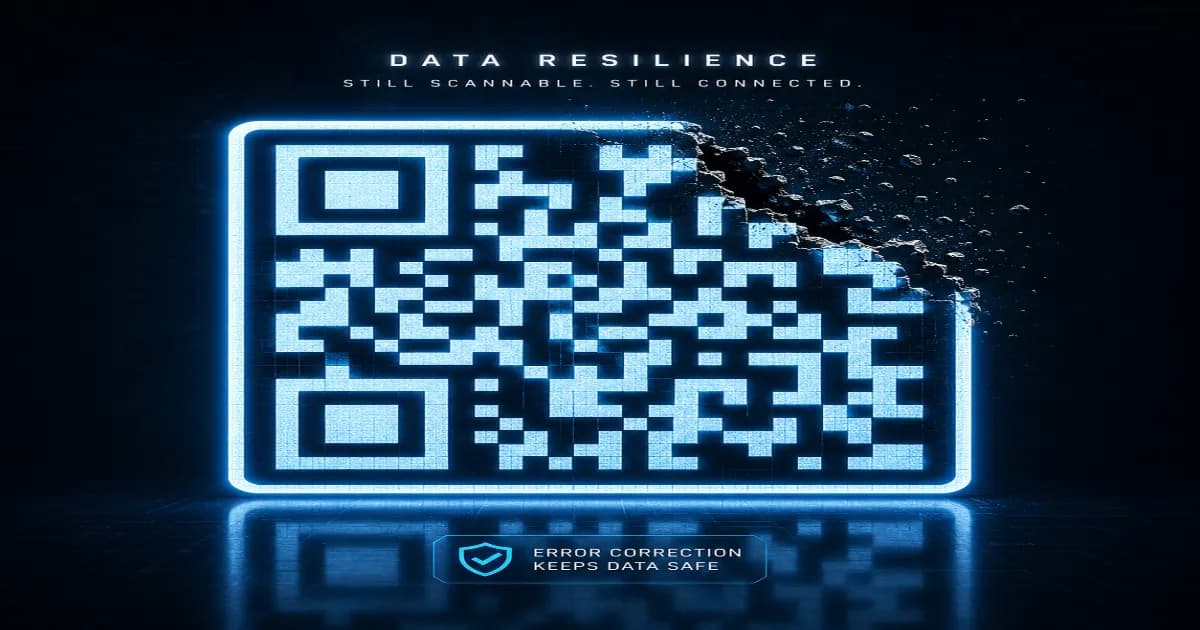
At the core of this reliability is the Reed-Solomon error correction algorithm. Originally developed in the 1960s to ensure reliable data transmission from deep space probes like the Voyager missions, this mathematical marvel was later adapted for CDs, DVDs, and eventually, the modern QR code (Quick Response code). When you generate a code, the software doesn't just encode your website URL; it mathematically calculates and embeds backup data throughout the matrix. This means the exact same piece of information is essentially repeated or reconstructible based on the surrounding pixels. If a corner gets torn off a poster, the scanner mathematically reconstructs the missing data on the fly.
The Four Levels of Correction
To balance storage capacity with durability, the standard allows you to choose between four distinct error correction levels.
- Level L (Low): Can restore up to 7% of damaged data. This is ideal when you need a very simple, uncluttered image and the code will be displayed safely on a digital screen.
- Level M (Medium): Can restore up to 15%. This is the most common default setting, offering a great balance between matrix density and reliability for standard print materials.
- Level Q (Quartile): Can restore up to 25%. Frequently used in industrial settings or when adding small logos.
- Level H (High): Can restore a massive 30% of damaged data. This is essential for outdoor advertising, heavy warehouse use, or when embedding large custom graphics directly into the center of the code.
Why This Matters for Custom Design
If you want to place your brand's logo in the middle of a code, you are intentionally "damaging" the data in that specific area. By setting the correction to Level H, the algorithm anticipates this 30% data loss and ensures the code remains perfectly scannable. This is a crucial consideration when comparing static vs dynamic QR codes. Because dynamic codes hold less data (just a short URL), they naturally create a simpler matrix. When you apply Level H correction to a simple dynamic code, it remains clean and extremely fast to scan, even with a large logo covering the center.
Real-World Durability
The robust nature of these matrices makes them far superior to traditional 1D formats in rugged environments. You can explore more about these limitations in our QR code vs barcode comparison. Whether printed on a shipping container exposed to rain, a restaurant table where drinks might spill, or a billboard subject to fading sunlight, the built-in redundancy ensures your customer can still access your digital content without frustration. However, while the technology is resilient against physical damage, you should also consider digital security; learn more in our article discussing are QR codes safe from scams.
Build Resilient Codes Today
Understanding these technical settings empowers you to create marketing materials that actually work in the real world. You don't have to be a mathematician to take advantage of deep space algorithms. Create your QR code now and our platform will automatically apply the optimal error correction settings to ensure your campaigns are always a success.
Create your QR code for free
No sign up, no limits — generate and download in seconds.
Open the generator